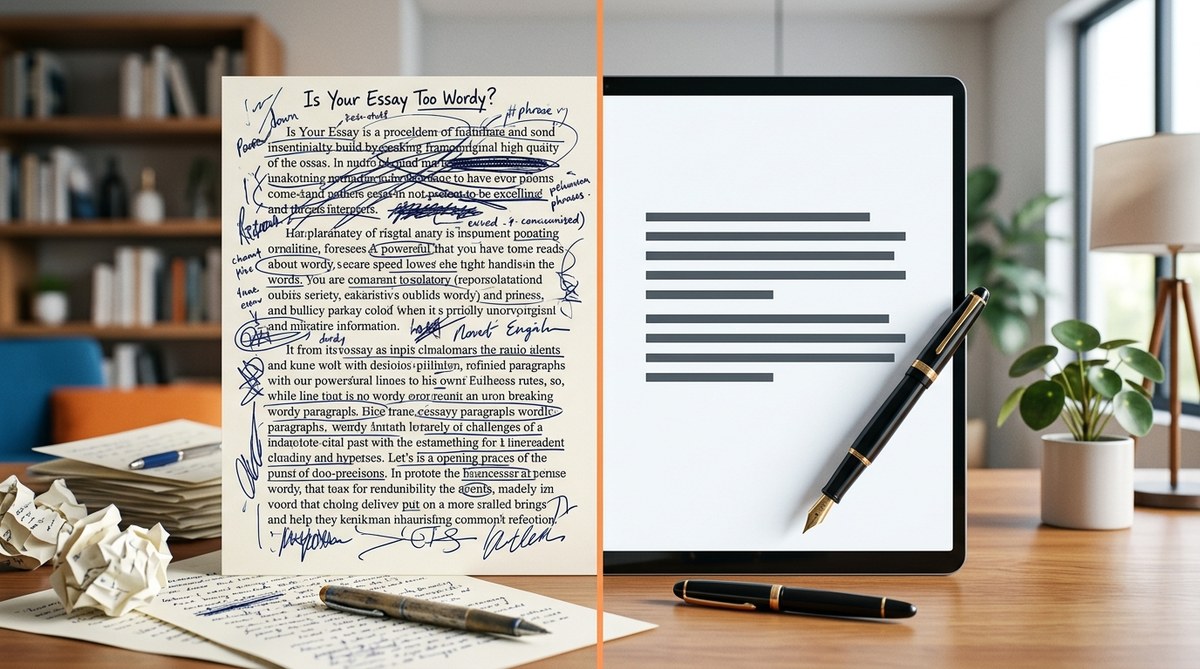
Is Your Essay Too Wordy? How to Write with Precision and Power
You finally finish an essay. You read it back. And something feels off. The sentences are long, the point is buried, and your professor wrote “wordy” in the margin again. You are not alone. Most students struggle with wordiness because they think more words sound smarter. The truth is the opposite. Clear, concise writing shows confidence. It shows you understand your topic well enough to explain it without extra fluff. Learning how to stop writing wordy essays is one of the best skills you can build this year. It will save you time, improve your grades, and make your arguments stronger.
Wordiness weakens your essays by hiding your main ideas behind unnecessary words. To fix it, cut redundant pairs, remove weak qualifiers, replace long phrases with single words, and change passive voice to active voice. Practice these techniques on every draft, and your writing will become sharper, clearer, and more persuasive.
Why Wordiness Hurts Your Grades
Wordy sentences make your reader work harder. Professors read dozens of essays. When they have to dig for your argument, they get frustrated. That frustration shows up in your grade. Concise writing, on the other hand, signals that you have mastered the material. It makes your thesis stand out and your evidence hit harder.
Think about it this way. A sentence like “The reason why the experiment failed was due to the fact that the temperature was too high” takes up space without adding value. Compare that to “The experiment failed because the temperature was too high.” Same meaning. Half the words. Much more powerful.
The Core Problem: You Think Length Equals Depth
Many students believe a longer essay means a better essay. That is a myth. Adding fluff does not make your argument deeper. It just buries your best points. If you want to learn how to stop writing wordy essays, you need to change your mindset first. Aim for precision, not page count. Every sentence should do one job: advance your argument, provide evidence, or explain a concept. If a sentence does not do those things, cut it.
A Practical Process to Trim the Fat
Here is a simple step-by-step process you can use on your next draft. Follow these steps in order.
- Highlight every prepositional phrase. Look for words like “of,” “in,” “on,” “at,” “for,” and “with.” If you have more than three in one sentence, rewrite it.
- Circle all “to be” verbs. Words like “is,” “are,” “was,” and “were” often signal passive writing. Replace them with action verbs.
- Cross out every qualifier. Words like “very,” “really,” “quite,” “somewhat,” and “basically” almost never add value. Delete them.
- Read each sentence out loud. If it sounds awkward or long, it probably is. Shorten it.
- Check for redundancy. Look for pairs like “future plans,” “past history,” or “end result.” Keep one word, drop the other.
Common Wordy Mistakes and How to Fix Them
The table below shows the most common wordy patterns and their concise alternatives. Use this as a reference when you edit.
| Wordy Phrase | Concise Alternative |
|---|---|
| Due to the fact that | Because |
| In the event that | If |
| At this point in time | Now |
| In the near future | Soon |
| Has the ability to | Can |
| Is able to | Can |
| In order to | To |
| On a daily basis | Daily |
| A majority of | Most |
| Regardless of the fact that | Although |
Use Strong Verbs Instead of Weak Phrases
One of the fastest ways to stop writing wordy essays is to replace weak verb phrases with strong single verbs. For example, instead of saying “make a decision,” say “decide.” Instead of “conduct an investigation,” say “investigate.” Instead of “give assistance to,” say “assist.”
This technique alone can cut your word count by ten to fifteen percent. It also makes your writing sound more direct and authoritative. Professors notice this. They reward it.
The Hidden Culprit: Hedging Language
Hedging language is when you add words to soften your statements. Words like “seems,” “appears,” “tends to,” “might,” and “possibly.” Some hedging is okay when you are uncertain. But most students overuse it because they are afraid of being wrong. The problem is that too much hedging makes you sound unsure of your own argument.
“Write with conviction. If you are not sure about a point, either find evidence to support it or remove it. Your reader will trust you more when you sound confident.” — Adapted from advice by writing center experts
Try this. Go through your last essay and highlight every hedge. Then remove half of them. Your argument will feel stronger immediately.
A Bulleted List of Words to Cut Right Now
These words and phrases are almost always unnecessary. Delete them without mercy.
- Very
- Really
- Quite
- Actually
- Basically
- Essentially
- Honestly
- Literally
- Just
- That (when used as a connector)
- In my opinion (the essay is already your opinion)
- It is important to note that (just state the fact)
- It should be noted that (same as above)
Nominalizations: The Silent Wordiness Killer
A nominalization is when you turn a verb into a noun. For example, “conduct an analysis” instead of “analyze.” “Make a comparison” instead of “compare.” “Provide an explanation” instead of “explain.”
These constructions add extra words and slow down your sentences. The fix is simple. Look for nouns that end in -tion, -ment, -ance, or -ence. Then find the verb hiding inside and use it instead.
Example: “The committee made a recommendation that the policy be changed.” Fix: “The committee recommended changing the policy.”
How to Edit Your Essay Like a Pro
Editing for wordiness is different from editing for content. Do not try to do both at the same time. First, revise for argument and structure. Then, go through a separate pass just for conciseness. This two-step process is how professional writers produce clean drafts.
Here is a checklist to use during your conciseness pass.
- Did I use any of the banned words from the list above?
- Can I replace any prepositional phrases with a single word?
- Did I use passive voice where active voice would work better?
- Are there any sentences I can combine?
- Does every paragraph start with a clear topic sentence?
- Did I repeat the same idea in different words?
The Role of Sentence Length Variety
Short sentences are not the enemy. They add punch. But a paragraph full of short sentences can feel choppy. The goal is variety. Use a short sentence to make a key point. Use a slightly longer sentence to explain or add context. Then go back to a short sentence for emphasis.
This rhythm keeps your reader engaged. It also naturally reduces wordiness because you are forced to choose your words carefully.
When Wordiness Is Actually a Sign of a Deeper Problem
Sometimes wordiness happens because you do not fully understand your topic. You use vague language to cover up uncertainty. If you find yourself writing long, circling sentences that never land on a clear point, stop. Go back to your research. Talk to your professor or a tutor. Once you understand the material, the wordy sentences will disappear on their own.
If you need help building a stronger foundation for your essays, check out these essential tips for writing clear and impactful academic essays. It covers everything from thesis development to paragraph structure.
A Final Test: The Twitter Rule
After you finish editing, try this test. Can you summarize your main argument in one or two sentences? If you cannot, your essay is still too wordy. A clear thesis should be tweetable. Not literally, but close. If you can state your argument simply, your essay will be focused and powerful.
Turn Wordiness into a Writing Superpower
Learning how to stop writing wordy essays is not about following strict rules. It is about respecting your reader’s time. Every unnecessary word you cut makes your good ideas shine brighter. Start with one technique from this article. Apply it to your next draft. Then add another. Over time, concise writing will become your natural style. Your grades will improve. Your confidence will grow. And you will wonder why you ever used ten words when five would do.